 Add to Chrome
 Add to Firefox
 Add to Edge
Limits of Resolution Equivariance in Fourier Neural Operators
May 30, 2026
Fourier Neural Operators are often assumed to generalize across spatial resolutions, enabling training on a coarse grid and deployment on a finer grid. We test this assumption by contrasting two inference-time choices when moving from training resolution $s$ to test resolution $S>s$: running FNO directly at $S$, or running at $s$ and upsampling the prediction to $S$ via Fourier zero-padding. On Darcy flow, we observe that direct fine-grid inference is not reliably beneficial and can be worse than the low-grid-plus-upsampling baseline. We further analyze layerwise spectra and find that, under Fourier truncation, intermediate representations increasingly concentrate energy in low frequencies, with high-frequency output produced mainly by late nonlinear/decoder stages. This offers a mechanistic explanation for why FNO can perform well while retaining few modes, yet remain sensitive under resolution shifts. Our findings highlight a simple but strong baseline for cross-resolution evaluation and point to nonlinear aliasing as a key obstacle to zero-shot resolution equivariance.

Forward Only Learning for Orthogonal Neural Networks of any Depth
Dec 19, 2025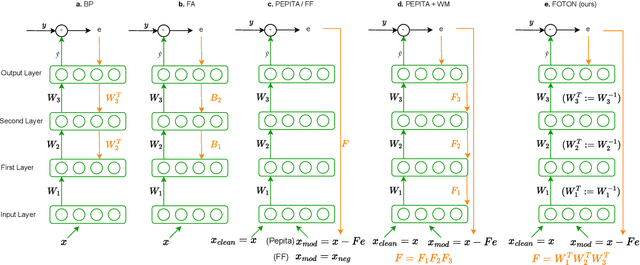
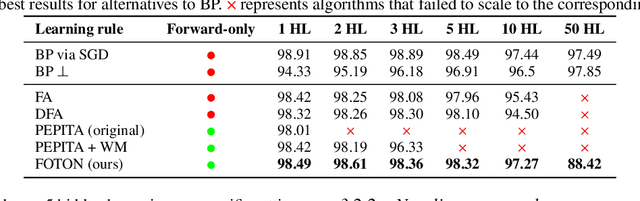

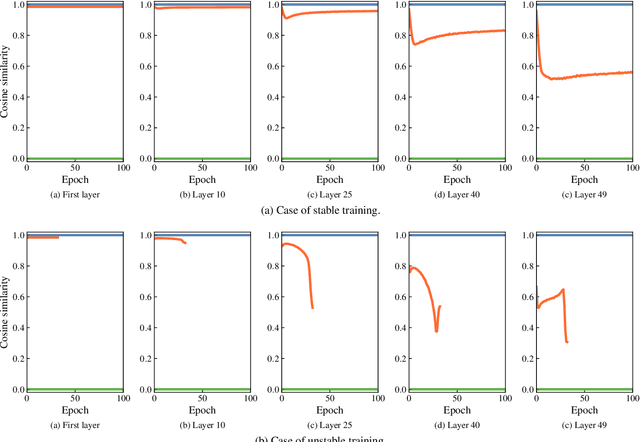
Backpropagation is still the de facto algorithm used today to train neural networks. With the exponential growth of recent architectures, the computational cost of this algorithm also becomes a burden. The recent PEPITA and forward-only frameworks have proposed promising alternatives, but they failed to scale up to a handful of hidden layers, yet limiting their use. In this paper, we first analyze theoretically the main limitations of these approaches. It allows us the design of a forward-only algorithm, which is equivalent to backpropagation under the linear and orthogonal assumptions. By relaxing the linear assumption, we then introduce FOTON (Forward-Only Training of Orthogonal Networks) that bridges the gap with the backpropagation algorithm. Experimental results show that it outperforms PEPITA, enabling us to train neural networks of any depth, without the need for a backward pass. Moreover its performance on convolutional networks clearly opens up avenues for its application to more advanced architectures. The code is open-sourced at https://github.com/p0lcAi/FOTON .
Linear Attention with Global Context: A Multipole Attention Mechanism for Vision and Physics
Jul 03, 2025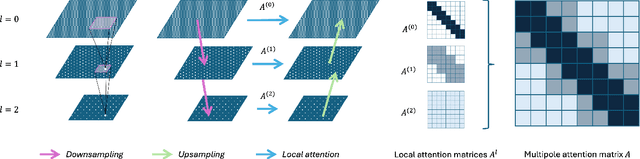


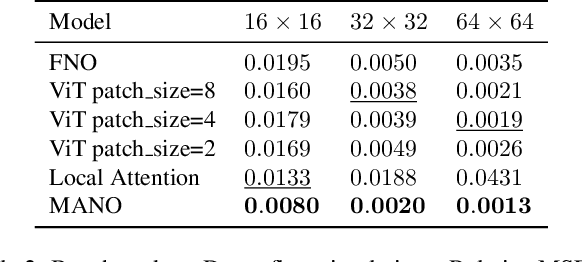
Transformers have become the de facto standard for a wide range of tasks, from image classification to physics simulations. Despite their impressive performance, the quadratic complexity of standard Transformers in both memory and time with respect to the input length makes them impractical for processing high-resolution inputs. Therefore, several variants have been proposed, the most successful relying on patchification, downsampling, or coarsening techniques, often at the cost of losing the finest-scale details. In this work, we take a different approach. Inspired by state-of-the-art techniques in $n$-body numerical simulations, we cast attention as an interaction problem between grid points. We introduce the Multipole Attention Neural Operator (MANO), which computes attention in a distance-based multiscale fashion. MANO maintains, in each attention head, a global receptive field and achieves linear time and memory complexity with respect to the number of grid points. Empirical results on image classification and Darcy flows demonstrate that MANO rivals state-of-the-art models such as ViT and Swin Transformer, while reducing runtime and peak memory usage by orders of magnitude. We open source our code for reproducibility at https://github.com/AlexColagrande/MANO.